Why individual training complements team sessions — and does not replace them
6 min
Team sessions are essential for a footballer’s development, but they rarely leave enough room for each player’s individual details. Here’s the role personal work can play.
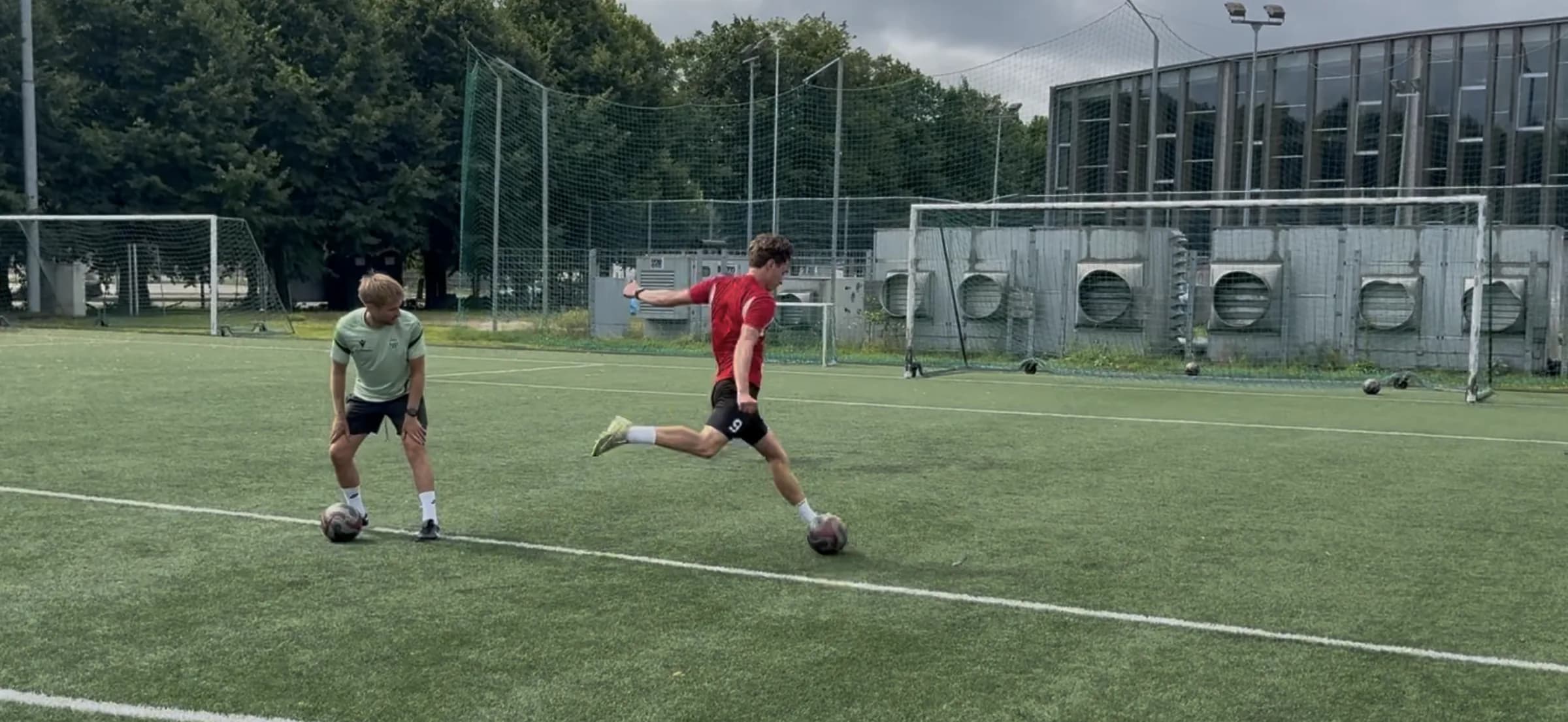
Almost every parent who first considers individual sessions asks me the same question: the child already trains at a club several times a week — why add anything else?
It is a fair question. From the outside, individual training can look like a repeat of what already happens in the team. In practice it works differently. Team and individual sessions do not compete, because they solve different problems. And most often a player progresses faster when the two go together.
I still play myself and coach at Levadia U21, so I see this from both sides. A team session has its own main purpose, and it is not to perfect every player’s technique. Its job is to teach the team to play together: to combine, read a teammate, create a numerical advantage, reorganise in defence and attack, and decide under conditions as close to a match as possible. A good team session cannot be replaced by individual work. But it is just as naive to expect that, in those conditions, a coach can dig deep into every footballer’s game.
Picture a normal children’s team session. Eighteen or twenty players are on the pitch at once. In ninety minutes the coach has to warm the group up, explain new exercises, organise game tasks and finish with a match. Even an experienced, attentive coach has limited time. One child struggles with the first touch, another needs more work on the weaker foot, a third has to learn how to move between the lines. Fixing all of that at once is simply impossible. That is not a question of coaching quality — it is the natural limit of any group session.
This is where individual work belongs. It does not replace the club; it creates space to focus calmly on one player. Often noticeable progress does not need a new method — it needs the chance to stop, repeat one action dozens of times, unpack the mistake and try again straight away. In a team session that is almost impossible. In an individual session, that is the main work.
So I never ask families to choose between the club and personal sessions. The team gives the game, competition and context. Individual training gives the time and attention to fix what still lets the player down in matches. When a child brings an already trained skill back into the team, every club session becomes more useful — and you can see it both in the football and in their confidence.